
Quantum Leap
Live Daily Accountability Coaching
So if you’re a six, seven or eight figure entrepreneur, we will help you hit your biggest business goals in half the time or even less compared to what you’re currently taking using our exclusive program called the Quantum Leap Accelerator.
My name is Mani Vaya. I’m the founder of 2000 Books and the founder of Focus Blocks.
If you want to double, triple or even quadruple your business goal achievement speed this year, this might be the most important seven minute video you will watch this year. Now you might be wondering how can I make a big Claim like that, especially when it comes to your business goals. Well, through our exclusive program called Quantum Leave, we’ve helped hundreds of high achieving six, seven, and eight figure entrepreneurs just like you achieve some huge results.
Meet, Teki Kaoloa
Teki owns a general contracting business. He was stuck at a glass ceiling of $45,000 a month for almost a year. When he joined Quantum Leave, his goal was to hit $66,000 that month. However, in his first month of Quantum Leap, he broke through and got to a hundred thousand dollars in revenue for that month, which was more than double of anything he had ever achieved before.
Then meet Akash Thakkar.
Akash is an online entrepreneur and freelancer from Seattle. Before Quantum Leap, he was struggling. He was working long hours and still missing deadlines. He was having a hard time keeping his clients. He was stuck at around 200, 000 a year.
However, within two months of Quantum Leap, he doubled his income. Not only that, instead of working late nights, he now finishes his work by 4 p. m. on most days.
And now meet Harish Nath.
He’s the co founder and CEO of Oscar IT Solutions. Before Quantum Leap, Harish’s business would do 15 to 18 sales per month and he was working till 9pm. on most days. Well, everything changed within one month of Quantum Leap. In the first month of Quantum Leap, his business did 60 sales. 6 0 sales while he started finishing his workdays by 4 pm On most days so he went from 18 sales to 60 sales while cutting down his workdays by 5 hours
And here’s Pam Malta.
She owns a real estate transaction coordination business in st Louis missouri before quantum leap. She was stuck at 8 to 9 clients max for over 20 years She was working from 5 30 a. m. To 11 p. m on most days She was stressed, she was burnt out, and she often thought of quitting. She had many business coaches who kept telling her what to do, but she was still drowning.
However, everything changed when she joined Quantum Leap. 3 months into Quantum Leap, she went from 8 clients to 23 clients. Yeah, using Quantum Leap, she tripled her business in 3 months, something she could not do on her own in 20 years. Not only that, instead of working till 11pm, she now finishes her work days by 4 p. m. on most days.
And meet Shelly Davis. She’s a realtor from Seal Beach, California. Shelly had been stuck at her income plateau for nearly eight years and could not break through. She often worked till 11 p. m. and her husband complained about it. Well, everything changed when she joined Quantum Leap. Within three months of Quantum Leap, she doubled her income. Not only that, she now finishes her workdays by 5 p. m. on most days.ap.
So you might be wondering, what is Quantum Leap and how are entrepreneurs getting such mind blowing results? So fast. Well, there are three core components of quantum leap that will get you super fast results.
The first component is eye on the prize goal tracking system. Let me show you how it works Now as you can see in this quantum leap eye on the prize goal tracking system You identify your biggest goals for the year then goals for the quarter and then you break it down further into goals for the month And then you break it down even further into goals for the week and then you break it down even further What do you need to accomplish today?
And as you make progress towards your goals, you’ll see your progress Spark, changing color, going from red to yellow to green and telling you how much progress you’re making every single day. Now, as you can see, this goal tracking system gives you ultimate clarity on what is truly the highest leverage, most important thing you need to do every single day in alignment with your goals for the year, for the quarter, for the month, for the week.
So that you’re always in alignment. You’re always have that clarity as what is the most important thing to do. Now, the thing is you probably tried goal tracking systems in the past, probably tried to write those goals in journals and diaries and apps and notebooks and all that stuff. And that doesn’t really work because there’s one thing that’s missing and that’s accountability.
And that is where the second component of quantum leap comes into play. The second component of quantum leap is daily clarity and accountability coaching calls Monday through Friday. Every day you jump on a. Quick coaching call with your accountability coach on video and your tracker is shared on the screen.
In the tracker, you check off what you got done yesterday. Let’s say you get these two items done. So you check them off. The bar goes from red to yellow. So now you’re going to have a discussion with your coach. Why didn’t you get this item done? What happened? What was holding you back? How can you make sure that you’ll make progress?
Questions like that, that’ll force you to stay accountable and get these important tasks done. And then you will make commitments for the day. Now, this is really important part because in order to make the right commitments, you need clarity on what is truly the most important, highest leverage tasks you need to do today.
That’s where the coach is going to ask you tough questions like, is this truly the right thing to do? Is this truly the thing that will help you hit your goals for the month or for the quarter, for the year? Are these really? The things that will help you move really fast. What else could you do to move faster?
Is there a way you can cut down the time? Is there a way you can do 20 percent effort and get 80 percent results? Now, this kind of questioning, this kind of back and forth discussion will force you to always think higher, always think about what is truly the most important thing that needs to be done today in order to hit your biggest goals for the year.
Now, as you can see, this combination of eye on the price tracking system and daily accountability and clarity coaching will give you alignments. Clarity and accountability every single day. And that will help you achieve your goals much, much faster compared to trying to figure it out by yourself. Now, as a result of this alignment, clarity, and accountability, you will finally make the transition from working harder to working higher.
Working on the highest leveraged projects and tasks that will bring you the greatest results in this week, in this month, in this quarter, in this year. But we didn’t stop there. There’s another key component of Quantum Leap that accelerates your goal achievement even further. Your daily accountability coaching call is not limited to you and your coach.
And that’s where the third component of Quantum Leap comes in. Your daily mastermind you get a mastermind group of four to five other high achieving entrepreneurs who are playing at a similar level to you So when you make your commitments every single day and you show up for these calls every single day You’re so much more likely to follow through on your commitments because you didn’t just make the commitment to your coach You made the commitment to the entire group who’s with you and as a result of this mastermind group of Other high achieving entrepreneurs you get new perspectives You get fresh ideas from each other and they will encourage you on this entire journey of entrepreneurship And you get daily support every single day You are on call with this daily mastermind of four to five other high achieving entrepreneurs and your accountability coach So that you are never alone in this journey of entrepreneurship Now as you can see these three key components of quantum leap will dramatically accelerate your goal achievement speed high on the price tracking system Daily clarity and accountability coaching and the daily mastermind quantum leap creates fast business growth Just like techie who doubled his revenue in a month or akash who doubled his income in two months or pam who tripled her business In three months or harish who forexed his sales in one month or shelly who doubled her income in three months and many many others
So the only question is do you want to be our next success story?
If you want to achieve your big business goals in half the time it will take you, I have two options for you.
- You can either pay right now and get started right away or
- Apply to get two weeks of Quantum Leap for free.
Now you might be wondering, why would we give away two weeks of Quantum Leap for free?
What’s the catch?
Well, here’s why. I am so confident that if you give your best to Quantum Leap for two weeks, it will transform your life and you will become a customer for life.
And that is why I’m literally I’m giving you 2 weeks of Quantum Leap membership worth 500 for free.
So it’s a win win for both of us.
You get to try Quantum Leap for free for 2 weeks and see if it works for you.
We get to win you as a customer for life.
You however will need to apply to get two free weeks. You will find the 2 week FREE application button below.
This is a serious application for truly ambitious entrepreneurs who want to accelerate their results. So please do not take this application lightly.
If your application is incomplete or lacking or doesn’t show excitement for Quantum Leap, it will be denied.
However, if you don’t want to wait for this application process and just get started right away, There’s another button below where you can go and purchase quantum leap membership right now.
Whichever way you choose, I’m looking forward to helping you achieve your biggest business goals and have the time it would take you by yourself.
SUMMARY
Rich Dad vs. Poor Dad
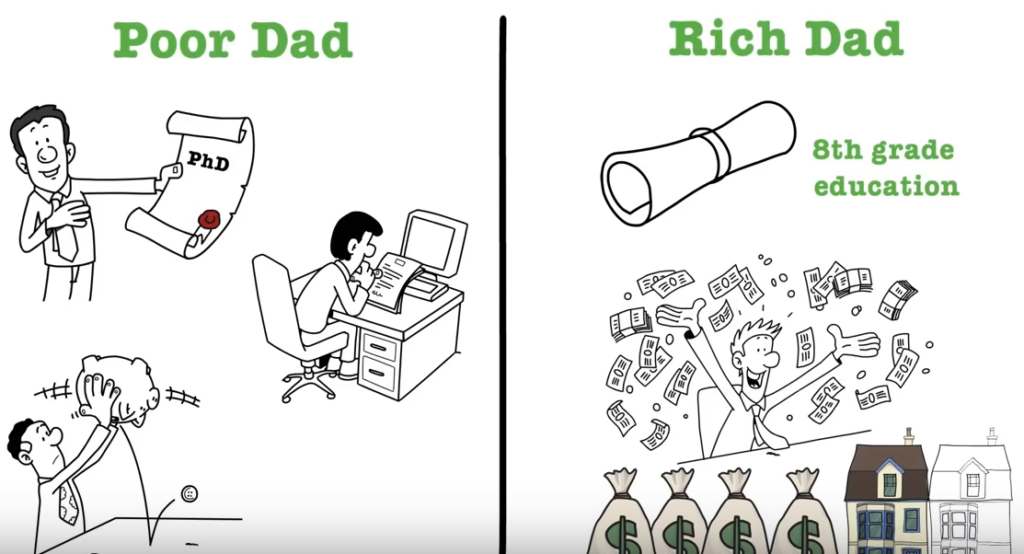
This book is the story of Robert Kiyosaki’s life in some ways as he talks about the 2 most influential figures in his life.
| RICH DAD | POOR DAD |
|
|
|
|
|
|
Financial Statements
Most people understand the difference between income and expenses, but they do not understand the difference between assets and liabilities.
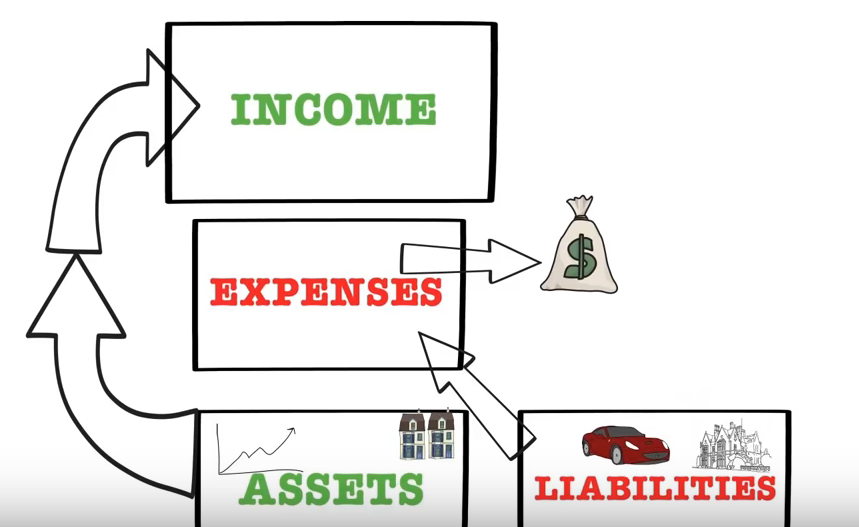
Asset
- Works for you
- Generates income for you even when you’re not working
- Examples:
- A cashflow-positive real estate investment that produces a thousand dollars’ income a month
- A business that produces income
Liability
- Always takes money out of your pocket even when you’re not using it
- Loses value every day
- Examples:
- A large house bought for personal use for which you are paying a lot of mortgage. This does not really put any money in your pocket.
- A big luxury car for personal use
Lesson 1: What Kind of Education to Get
This lesson is what we teach most kids when we start off.
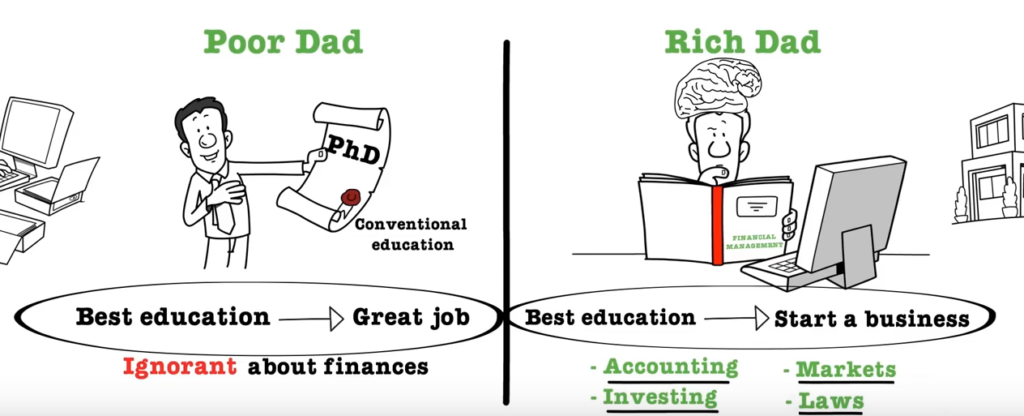
Poor Dad’s advice: Go ahead and get the best possible education in order to get a great job.
Poor Dad believed in conventional education. He was a teacher himself but he never really learned about money. He was an educated, intelligent man, had a PhD, but he was ignorant when it came to finances.
Rich Dad’s advice: Go and get the best possible education so that you can start your own business and give other people jobs.
Unlike the educated Poor Dad, Rich Dad only had an 8th grade education. He believed in the kind of education where he was constantly feeding his mind about business and finances.
4 key areas of financial education that Rich Dad always emphasized on:
- Accounting
- Investing
- The market
- The laws surrounding financing and money
Your greatest asset: Your mind
Kiyosaki emphasizes that financial literacy is the only way to get rich, not some quick scheme or formula. He encourages people that while the major areas of financial education, particularly accounting and the laws, can be complex, they are fundamental for making money for the long term.
Parents should start their kids early on accounting basics in the simplest and clearest ways possible so that it would be easier for them to have a grasp of this knowledge as they grow.
The lesson: This lesson shows a huge difference in mindset. Instead of focusing on conventional education, we need to think about educating ourselves financially and in everything else that goes around building a financial portfolio or business.
Lesson 2: What Kind of Work to Do
This is one of the most important lessons from the book.
Let’s say you’ve gone to college and you graduate, what do you do next? What kind of work should you do?
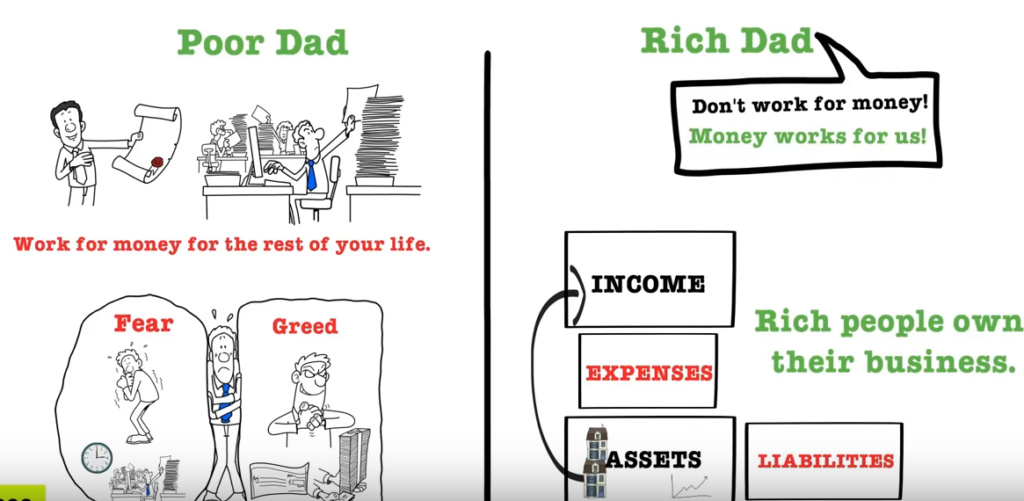
Here’s the key:
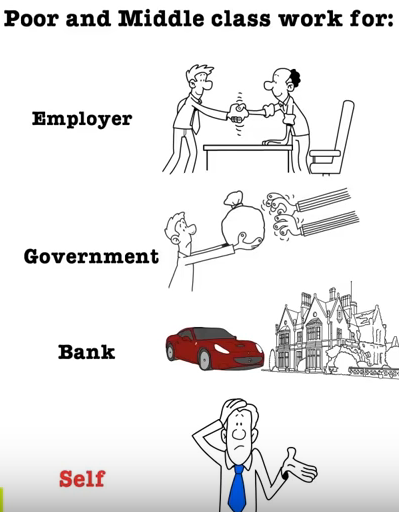
- The poor and middle class get a degree and get a job. They work for money and for others for the rest of their lives.
- The first person to work for is their employer.
- Then they work for the government because the government takes taxes as soon as they receive an income.
- Then they work for the bank because they buy a big house and a big car. They’re paying mortgage and interest to the bank.
- Only after they have have worked for the employer and the government and the bank do they really start to work for themselves…and then they wonder why they’re not rich.
- Fear and greed run their lives. They have this fear of not having enough money so they keep on working hard on their job and keep on trying to make more and more money. They’re fearful of starting their own business or venture.
- They’re stuck in a rat race.
- The rich don’t work for money, rather it’s money that works for them.
- Rich Dad’s mantra was to work to improve upon assets, which in turn produce income.
- Rich Dad was always acquiring and growing his assets like businesses and cashflow-positive real estate, stock, and other investments, and that’s what rich people do.
- Rich people own their businesses and then they leverage corporate structures and taxation to their advantage.
Lesson 3: How to Invest/Spend Money
Let’s say you have your education and you have a job or a business. How do you invest or spend your money?
The key: Pay yourself first.
You probably know a lot of people who are making lot of money but are still broke; they have almost no real tangible assets. Meanwhile, some people are not even making as much money as them but are rich.
It’s all about when they pay themselves.
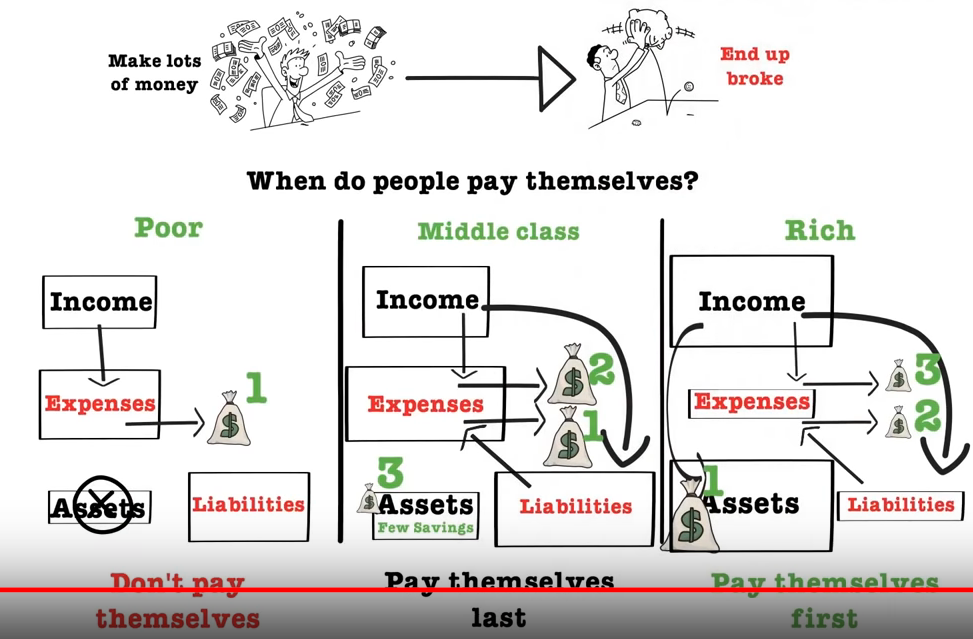
The poor:
- They never get around to paying themselves at all.
- As soon as they get their income, it goes out into expenses.
- They never put it into an asset.
- They’re ignorant about how money works.
The middle class:
- They pay themselves last.
- They start with a certain amount of income then spend it up on liabilities. These liabilities are big on expenses and so the money goes out of their expense column.
- They have very limited assets. They probably have retirement savings, bank savings or some sort of housing, but that’s a barrier.
- They might have higher income, but then they also have higher liabilities, which in the end keep taking money out of their pockets.
- They acquire limited assets and they get almost no income from these because they are limited.
The rich:
- They pay themselves first.
- As soon as any income comes in, they invest a portion of it into their assets. Their money is employed right away.
- The remainder of their income is then used for expenses and liabilities.
- They ensure that their expenses are much lower than their income, and their liabilities are much lower than their assets.
Limit Your Risks, Increase Your Sales
Avoid being taxed
Since the rich have the financial knowledge on the workings of the business structures, they are able to avoid the rules surrounding taxes. Meanwhile, the middle class, due to their lack of this kind of education, end up being punished by the taxes.
The rich avoid paying more taxes by doing their research and pushing back whenever there are new initiatives meant to tax them.
Incorporate
Kiyosaki calls it a basic fact of life that the rich somewhat control the financial system to their benefit. His advice is to incorporate in order to limit risks.
A typical corporation protects the rich, and you should let it protect you as well. Corporations in the United States, for instance, enjoy various advantages in the areas of finance.
Help others sell
Kiyosaki also encourages people to practice the “principle of reciprocity” by helping someone else sell something. If you want sales, this can have huge impact on your business. The idea is that you get back whatever you give out.
Be Bold

The road to richness may be a long one but it’s worth the taking. Besides, we are all after freedom and abundance in life. But why are many of us still stuck or struggling financially?
Major roadblocks getting in our way:
- Fear
Many of us fear failing along the way, or fear losing all our hard-earned money. We also fear how the society would see us. But Kiyosaki says that failure is actually a part of financial education.
If we fear failure, we would not take risks or create ventures for ourselves. Being too concerned with it hinders us from learning and growth and from the richness we are actually capable of attaining.
What to develop in ourselves to defeat fear:
– Patience
– Courage
– Bold thinking toward failure
- Laziness
Laziness will also not get us anywhere. To defeat laziness, Kiyosaki suggests applying a certain amount of greed. Greed spurs motivation and desire to do something great.
- Arrogance / lack of financial IQ
This is the ultimate roadblock in this journey. Ego and ignorance of finances means lost money and opportunities. Worse, the arrogant person is not aware of it.
Again, Kiyosaki says that self education is the key to step up one’s finances. Be willing to honestly assess what aspects of financial education you need to know more of, and be open to learning.

If we clear these blocks away from our path, the journey to riches would generally be a smoother one. Start now.
Related Readings:
- How to Get Rich by Felix Dennis
- Profit First by Mike Michalowicz
- The Millionaire Fastlane by MJ Demarco
- Think and Grow Rich by Napoleon Hill